Choosing the right Custom Bakery Boxes is more than selecting an attractive color or printed logo. For global buyers, the box must protect delicate pastries through storage, handling, and long-distance delivery. A crushed corner can damage a brand’s reputation quickly. A weak grease barrier can ruin the customer experience.
Lisa McTigue Pierce, a respected packaging industry analyst, often emphasizes this principle: “Packaging is the product’s first impression.” That idea matters greatly in bakery packaging. The right box should balance food safety, structural strength, moisture resistance, and visual appeal. It should also match the product, whether it holds macarons, cupcakes, cookies, or celebration cakes.
No box is perfect.
Material choice requires careful judgment. Kraft paper may support a natural brand image, while coated paperboard can provide sharper printing and better surface protection. Windows improve product visibility, but they may affect recyclability and cost. Buyers should also review food-contact documentation, printing standards, minimum order quantities, and shipping performance before placing a large order.
This guide examines seven strong Custom Bakery Boxes options for international purchasers. Each option is considered through practical details, including closure design, internal support, customization flexibility, and sustainability. Some premium features may not suit every bakery. That is worth admitting. The best box is not always the most expensive one. It is the one that protects the product, communicates trust, and performs consistently across markets.
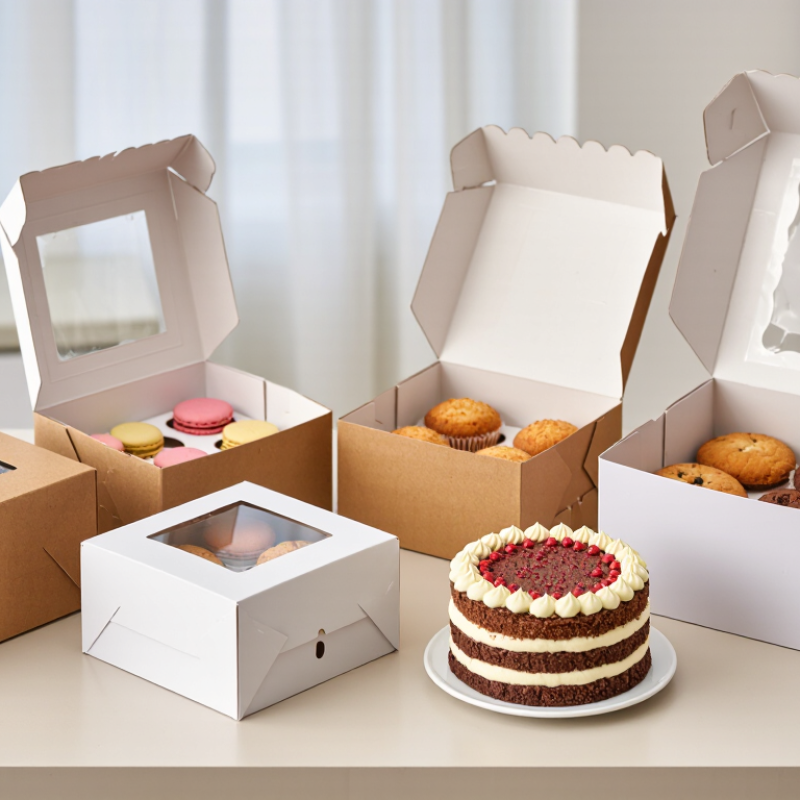
What Makes a Custom Bakery Box Ideal for Global Buyers
What Makes a Custom Bakery Box Ideal for Global Buyers
An ideal custom bakery box must protect food, communicate clearly, and survive long logistics routes. The seven strongest features are food-safe board, accurate sizing, grease resistance, moisture control, compression strength, adaptable printing, and responsible disposal. Grand View Research estimated the global bakery products market at about US$594 billion in 2023. That scale increases the cost of damaged pastries and unclear packaging.
Material choice deserves practical testing. A rigid paperboard base can prevent crushed corners, while a suitable inner coating helps resist butter and frosting. However, “eco-friendly” should not become a vague promise. Smithers’ packaging research forecasts the global packaging market will exceed US$1.2 trillion by 2028, with sustainability remaining a major purchasing factor. Buyers should request fiber content, coating details, and recyclability evidence. Small defects travel.
Global usability also depends on dimensions and information. A box should fit a six-inch cake without sliding, yet leave enough headspace for decoration. Folded samples and compression tests are more reliable than screen proofs. Labels may need ingredients, allergens, storage instructions, country-specific symbols, and multiple languages. I would not treat one universal design as perfect; customs rules, humidity, and delivery distances vary. A clear dieline, stable color reproduction, and documented food-contact compliance make supplier evaluation more dependable. Good packaging looks attractive. Better packaging arrives intact.
Seven Custom Bakery Box Styles for Different Products and Markets
7 Best Custom Bakery Boxes for Global Buyers
Seven Custom Bakery Box Styles for Different Products and Markets
Custom bakery boxes should match the product, delivery route, and buying habits of each market. A rigid cake box protects tall decorations during transport. A window tuck-end box displays cookies, pastries, and small breads at retail counters. Cupcake boxes with molded inserts reduce movement and frosting damage. For fragile pies, a strong one-piece carton with ventilation helps manage moisture. These details matter more than decoration alone. According to Smithers’ packaging industry forecasts, e-commerce continues to increase demand for protective, shipment-ready formats. A weak box can quickly erase the value of premium baking.
Sixth, drawer-style boxes suit gift assortments and seasonal products. They create a slower opening experience, which can support premium positioning. Seventh, handled gable boxes work well for takeaway bread, muffins, and mixed pastry orders. They are practical for local delivery and open-air markets. Grand View Research reports that the global bakery products market is expanding steadily, with convenience and packaged formats supporting growth. That trend does not make every box suitable. Market habits still differ.
Material selection needs testing. Recycled paperboard may support sustainability goals, but moisture resistance can vary. The Sustainable Packaging Coalition emphasizes designing packaging around actual use and recovery systems. I would test stacking, grease resistance, and cold-chain exposure before approving artwork. Not every window works. Some lids bow under heat. Some inserts fit poorly after manual packing. Small defects become expensive at scale, so sampling across suppliers and climates remains necessary.
7 Best Custom Bakery Boxes for Global Buyers
Typical internal box dimensions for seven custom bakery box styles, shown in centimeters. These practical reference sizes are suitable for comparing product capacity and packaging requirements across international markets.
How to use this chart: Select the box style according to the bakery product, portion size, protection needs, and local delivery conditions. Final dimensions should be adjusted for product height, inserts, padding, and sealing requirements.
Key Materials, Sizes, and Design Options to Compare
7 Best Custom Bakery Boxes for Global Buyers
Choosing bakery boxes for global sales requires more than attractive printing. Material, size, and structure affect freshness, shipping safety, and customer experience. Kraft paperboard suits cookies, pastries, and dry cakes. It feels natural and handles light use well. Corrugated board offers stronger protection for parcel delivery. Grease-resistant paperboard helps prevent oily marks. Food-contact suitability must be confirmed with the packaging supplier and checked against the destination market’s requirements.
The best custom formats include tuck-top boxes, window boxes, cake boxes, cupcake boxes with inserts, drawer boxes, corrugated mailers, and tall pastry boxes. A clear window displays decoration, but it can weaken insulation slightly. Cupcake inserts should hold each piece firmly without crushing frosting. Cake boxes need enough height for cream layers and toppings. Measure the product after decoration, not before. A few extra millimeters can prevent damaged edges.
Design choices should support real handling. Choose locking tabs for quick packing and a reinforced base for heavier cakes. Use one-color printing when budget and recycling matter. Add internal dividers for mixed pastries. I once tested a box that looked strong, but its corners softened after refrigerated storage. That mistake showed why samples matter. Check stacking, moisture, grease, and opening tests before ordering. Some printed finishes look premium, yet they may slow recycling or increase costs. A practical design often performs better than a perfect-looking one.
Food Safety, Branding, and International Packaging Requirements
7 Best Custom Bakery Boxes for Global Buyers
Food safety should guide every custom bakery box decision. The seven strongest options include
folding cartons,
grease-resistant pastry boxes,
window boxes,
cake boxes with inserts,
corrugated mailers,
rigid gift boxes, and
paperboard boxes with sleeves. Each format serves a different shipping and presentation need.
A window box improves product visibility, while an insert protects delicate decoration during transport.
Corrugated mailers offer better cushioning for international deliveries.
The World Health Organization estimates that contaminated food causes about
600 million illnesses and
420,000 deaths each year. That figure makes material selection more than a branding choice.
Use food-contact paperboard,
low-migration inks, and
adhesives approved for the destination market. European buyers may expect compliance with Regulation (EC) No 1935/2004, while United States shipments often require relevant FDA food-contact compliance. Requirements still vary by country.
Check them directly.
Branding must survive moisture, grease, friction, and customs handling. Smithers’ The Future of Global Packaging to 2028 forecasts the packaging market will exceed
1.2 trillion US dollars by 2028, increasing pressure for efficient, responsible designs.
Recyclable fiber helps, but coatings can complicate recycling. A glossy finish may look premium, yet it can weaken sustainability claims. Test print durability, odor transfer, compression strength, and migration before printing thousands of units.
Test before printing. Mistakes are expensive.
How to Select the Right Bakery Box Supplier Worldwide
7 Best Custom Bakery Boxes for Global Buyers
How to Select the Right Bakery Box Supplier Worldwide
Choosing a bakery box supplier requires more than comparing prices. I have reviewed packaging samples where attractive printing hid weak corners and poor folding accuracy. Request prototypes before placing a large order. Test them with real cakes, cream, cookies, and chilled products. Seven useful formats include tuck-top boxes, window boxes, cake boxes, cupcake boxes, macaron boxes, insert boxes, and recyclable kraft boxes. Each design serves a different product and shipping condition.
A reliable supplier should provide food-contact material information, production details, and clear quality controls. Ask about board thickness, coating, ink safety, moisture resistance, and insert stability. Request photos from recent production runs. Better still, inspect a physical sample. Printing can vary between batches. That detail is easy to overlook. Check minimum order quantities, tooling charges, lead times, and export packing. A low unit price may become expensive after freight, damage, and customs delays.
Global buyers also need dependable communication. Confirm time zones, response speed, payment terms, and replacement procedures for defective cartons. Suppliers should explain their sustainability claims with measurable material data, not vague language. I once approved a box based on a digital proof, but the finished color looked duller. Now, I request a printed proof under natural light. My process is still not perfect. However, careful testing reduces costly surprises and helps match each bakery product with the right box structure.
FAQS
Useful options include folding cartons, window boxes, cake boxes, cupcake boxes, insert boxes, kraft boxes, and corrugated mailers. Each format serves a different product. Choose based on protection, visibility, and shipping conditions.
Cake boxes with inserts help stabilize decorations and prevent movement. The insert should fit firmly without crushing frosting. Test it with a real cake. Paper samples alone can mislead.
Choose a window box when product visibility supports sales. It works well for cookies, pastries, and decorated cupcakes. Check whether the window stays clear after chilling. Moisture can create fogging.
Use food-contact paperboard, suitable inks, and approved adhesives. Confirm compliance with the destination market’s requirements. Ask for written material information and migration testing. Do not rely on attractive claims alone.
Request a physical prototype and a printed proof. Fill it with cake, cream, cookies, or chilled products. Check folding accuracy, odor, grease resistance, compression, and color. Test under natural light. Small flaws matter.
Ask about board thickness, coatings, ink safety, moisture resistance, inserts, and production controls. Also confirm minimum order quantities, tooling costs, lead times, and export packing. Request recent production photos. A sample is better.
Corrugated mailers provide stronger cushioning for long-distance deliveries. Use secure inserts for fragile decorations and rigid structures for premium gifts. Test stacked boxes and rough handling. Customs handling is not gentle.
Recyclable fiber can reduce environmental impact, but coatings may complicate recycling. Glossy finishes can weaken sustainability claims. Ask for measurable material data. The answer is rarely simple.
Confirm response times, time-zone coverage, payment terms, and defective-product procedures. Agree on replacement responsibilities before production begins. Printing may vary between batches. My process is not flawless. Careful records still help.
Conclusion
Choosing the right Custom Bakery Boxes is essential for protecting baked goods, strengthening brand presentation, and meeting the expectations of customers in different markets. This guide explores seven practical box styles for products such as cakes, pastries, cookies, cupcakes, and gift assortments. It explains how box structure, materials, sizes, closures, windows, inserts, and printing options can be compared according to product shape, weight, shelf life, and shipping conditions.
The article also highlights the importance of food-safe materials, secure construction, clear labeling, and packaging practices that support international distribution requirements. From compact retail boxes to elegant presentation packaging, each style offers different advantages for appearance, protection, storage, and customer convenience. Finally, global buyers will learn how to evaluate suppliers by reviewing material quality, customization capabilities, production consistency, communication, shipping support, and reliable quality control, helping them select packaging that balances cost, performance, sustainability, and market appeal.