In 2026, wholesale soap buyers need packaging that protects products and communicates value. Custom Soap Boxes can support both goals when design decisions begin with real product requirements. A handmade bar with textured edges needs a snug fit. A scented soap may need a suitable inner barrier. Moisture, transport pressure, shelf stacking, and storage temperatures also matter. Attractive artwork cannot correct weak construction.
Experienced packaging teams usually review board grade, box style, printing method, and closure strength together. Kraft paper can create a natural appearance, while coated white board often produces sharper colors. Recyclable materials may support responsible brand messaging, but buyers should verify supplier claims carefully. “Eco-friendly” should not remain an empty label. Ask for material specifications, product samples, testing details, and consistent production records.
Small details become visible at wholesale scale. A poorly aligned logo, crushed corner, or loose tuck flap can affect retailer confidence. We have seen packaging look excellent on screen yet feel disappointing in hand. That gap deserves attention. Digital proofs are useful, but physical samples reveal stiffness, texture, odor, and color variation. Some choices may need revision.
This guide examines practical options for wholesale buyers seeking reliable Custom Soap Boxes. It considers branding, protection, pricing, minimum order quantities, and production consistency. The best box is not always the most decorated one. It is the package that arrives intact, fits the soap accurately, and supports repeat purchasing. That sounds simple. It rarely is.
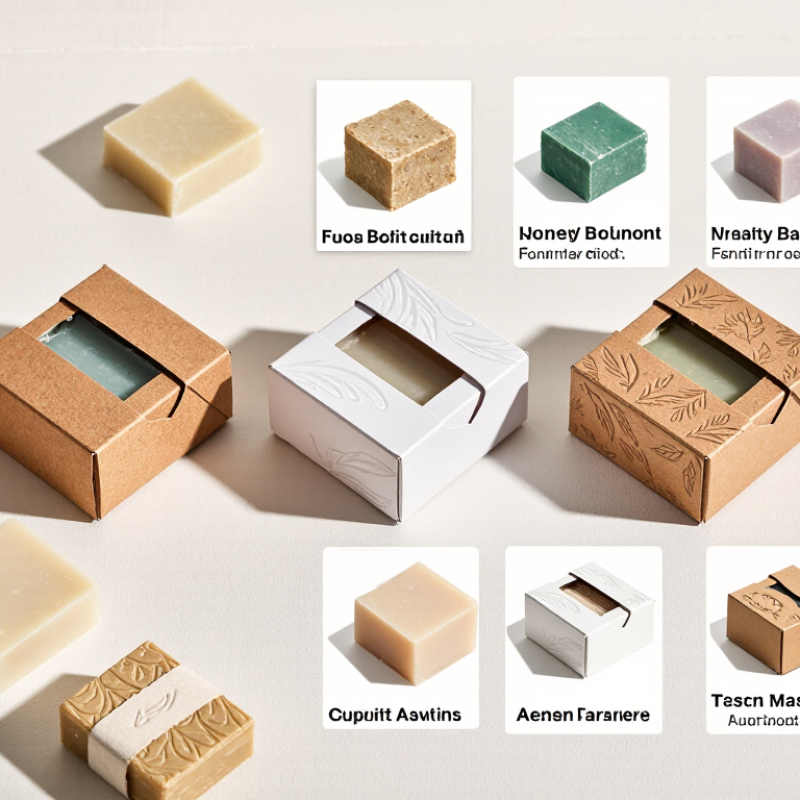
Custom soap boxes are folding paperboard packages designed around a soap bar’s dimensions, weight, and presentation needs. They protect products from dust, moisture, scuffing, and handling damage. Their purpose extends beyond protection. A measured box can improve shelf visibility, simplify storage, and support consistent wholesale presentation.
Grand View Research estimated the global soap market at approximately USD 44 billion in 2023. Its forecast suggests continued growth through 2030. That expansion increases pressure on packaging buyers to reduce waste and control unit costs. Custom dimensions can limit empty space and lower carton-volume requirements during transport. Small details matter. A tuck-end box, rigid setup box, or sleeve serves different budgets and packing speeds.
For wholesale applications, buyers should check board thickness, coating, print accuracy, batch consistency, and minimum order quantities. Paperboard between 300 and 400 gsm often suits standard bar soap, but heavier products may need stronger construction. FSC-certified paper and water-based coatings can support sustainability claims, although certification must be verified through valid documentation. Smithers’ packaging outlook identifies fiber-based formats as a major area of packaging development, yet recycling performance depends on coatings and local collection systems. That point is often overlooked.
In practical sampling, I would test boxes beside damp hands, stacked cartons, and repeated opening. A beautiful sample can still fail during warehouse handling. Wholesale decisions should balance appearance, protection, production tolerance, and realistic end-of-life options. Keep it practical.
2026 Best Custom Soap Boxes for Wholesale Buyers
Key Materials and Structural Options for Soap Packaging
For wholesale buyers, material choice starts with soap weight, oil content, and shipping distance. Standard paperboard suits most wrapped bars and keeps unit costs predictable. Kraft board offers a warm, natural texture. White folding carton board supports sharper colors and cleaner ingredient panels. Recycled grades may vary in surface smoothness. Test them before approving a large run.
Moisture needs attention. A water-based coating can reduce scuffing without creating a heavy gloss. For high-oil soaps, use a tested barrier layer and allow enough internal clearance. A tight fit may look efficient, but it can split at the corners. Corrugated mailer boxes provide stronger protection for multipacks. Rigid boxes feel premium, yet they add storage weight and freight costs. They are not always the better choice.
Tuck-end cartons assemble quickly and suit many filling lines. Sleeve packaging reduces printed area but creates a useful display effect. Drawer boxes improve presentation, although manual packing may slow production. A die-cut window can show color and texture, but it may weaken the front panel. From packaging trials, I have learned to check compression, rub resistance, folding accuracy, and barcode readability. Do not trust a sample that only looks attractive. Real handling exposes flaws.
Key material and structural options compared by protection, printability, recyclability, and cost efficiency. Scores use a practical 1–5 planning scale based on commonly used soap-packaging characteristics.
Folding cartons made from kraft or solid bleached paperboard are typically suited to retail soap packaging, while E-flute corrugated structures provide additional protection for wholesale shipping and multipack formats.
2026 Best Custom Soap Boxes for Wholesale Buyers
For wholesale buyers, custom soap boxes must protect bars and sell quality at shelf level. Strong design starts with accurate measurements. Leave a small clearance around each bar, but avoid loose movement during shipping. A 300–350 gsm paperboard box often provides useful stiffness for standard soap sizes. However, moisture can weaken ordinary stock quickly. A water-based coating or light varnish helps, yet excessive coating may reduce recyclability.
The Sustainable Packaging Coalition reports that consumers increasingly expect packaging to support material recovery. McKinsey’s 2023 global packaging research also found that many consumers consider environmental impact when choosing products. Design details should reflect that concern. Use soy or water-based inks, limited colors, and clearly identified paper materials. A tuck-end structure can reduce assembly time. A die-cut window reveals the soap, but it may increase material use and weaken the front panel. That trade-off deserves testing.
Tips: Request a physical prototype before ordering in bulk. Check barcode contrast, fold accuracy, edge crushing, and scent transfer after 48 hours. Add a matte finish for a soft, natural appearance, or use selective gloss for small botanical details. Keep critical text above the bottom fold. I have seen attractive boxes fail because their labels disappeared under poor lighting. Design should be beautiful. It should also survive handling, stacking, and real retail conditions.
2026 Best Custom Soap Boxes for Wholesale Buyers
How to Evaluate Suppliers, Quality, and Production Standards
Wholesale soap boxes must protect the product and represent its value. Start by checking the supplier’s production experience, not only its product photos. Ask for recent samples made with the same paperboard, coating, and printing method. A polished sample can still mislead. Confirm the board thickness, paper weight, box dimensions, and folding accuracy in writing.
Inspect every sample closely. Press the corners and check whether they split. Rub the printed surface with a dry cloth. Fading or smearing suggests weak ink adhesion. Measure the box after assembly, especially if soap bars have tight tolerances. Small errors can cause crushed edges during packing. Request material specifications and basic quality records. Useful documents may include test reports, batch records, and documented compliance with packaging rules in your target market.
A dependable supplier should explain its quality control points clearly. These may include incoming material checks, color verification, die-cut inspection, and final sampling. Ask how defects are classified and how rejected units are handled. Production speed matters, but consistency matters more. Get a pre-production sample before approving the full order. Also confirm lead times, replacement terms, and carton loading details. A low quotation is not always a saving. I would compare total cost, waste, delivery risk, and communication quality. My own evaluation would remain cautious, because even a strong first order cannot guarantee every future batch.
| Evaluation Dimension | Recommended Wholesale Benchmark | Why It Matters for Soap Boxes | How to Verify | Relevant Production Standard |
|---|---|---|---|---|
| Paperboard Grade | Folding boxboard, solid bleached board, or coated recycled board suitable for folding cartons | Provides a clean print surface and sufficient stiffness for retail handling. | Request the material specification, technical data sheet, and a physical sample. | Material specification should identify board type, coating, basis weight, and caliper. |
| Basis Weight | Approximately 250–400 g/m² for most standard soap cartons; higher weights may be used for premium structures. | Affects stiffness, folding performance, shipping weight, and perceived quality. | Check supplier documentation and verify random samples with a calibrated basis-weight tester or laboratory service. | Use a consistent test method such as ISO 536 for paper and board grammage. |
| Board Caliper | Common folding-carton range: approximately 0.30–0.55 mm, depending on board grade and box size. | Controls folding accuracy, stacking strength, and the fit of the soap bar inside the carton. | Measure multiple points on production samples and compare the average with the approved specification. | Caliper measurement should follow a controlled paper-and-board thickness test method, such as ISO 534. |
| Moisture Control | Target stable moisture content appropriate for the board and production environment; avoid visibly curled, softened, or brittle cartons. | Excess moisture can cause warping, weak folds, ink defects, and poor glue performance. | Inspect cartons after conditioning and record moisture readings from different pallet locations. | Store and condition samples under controlled temperature and relative humidity before comparison. |
| Color Consistency | Approve a signed or digitally controlled color proof; use an agreed tolerance, commonly expressed as ΔE, for repeat orders. | Consistent color protects packaging identity across batches and production locations. | Compare press sheets with the approved proof under standardized lighting and use a spectrophotometer when color is critical. | Define the color space, lighting condition, measurement instrument, and acceptable ΔE tolerance in the purchase specification. |
| Print Resolution and Registration | Commercial carton printing with sharp text, clean barcodes, and stable registration; artwork should be supplied in print-ready vector or high-resolution format. | Prevents unreadable ingredients, distorted logos, barcode scanning failures, and visible color misalignment. | Inspect fine text, barcode readability, trapping, ink coverage, and die-cut registration on production samples. | Require documented prepress approval and barcode verification where retail scanning is required. |
| Die-Cutting and Creasing | Clean edges, accurate dimensions, uniform creases, and no excessive cracking on printed or coated surfaces. | Accurate converting ensures that cartons fold squarely and close without bulging or tearing. | Measure finished dimensions and fold samples repeatedly by hand or with the intended packing equipment. | Use an approved dieline with tolerances for cut size, score position, panel alignment, and glue flap width. |
| Adhesive and Seam Strength | Glue seams should remain closed during filling, transport, and normal retail handling without visible squeeze-out. | Weak seams can cause open cartons, product loss, and damage during shipment. | Perform manual peel checks and test filled cartons after conditioning and transport simulation. | Specify adhesive type, application pattern, curing time, and acceptable seam-failure criteria. |
| Surface Finishing | Choose matte or gloss aqueous coating, varnish, or laminate according to appearance, scuff resistance, and recycling requirements. | Finishing influences moisture resistance, scratch resistance, tactile feel, and shelf appearance. | Review rub resistance, coating uniformity, odor, blocking, and fold-crack performance. | The finish should be compatible with the board, ink system, folding process, and intended recycling route. |
| Packaging Safety and Odor | No unacceptable solvent, chemical, mold, or foreign odor; packaging must be suitable for the intended cosmetic or personal-care application. | Soap cartons may contact the product or its primary wrap, making odor transfer and material selection important. | Conduct sensory inspection and request declarations for inks, coatings, adhesives, and restricted substances. | Define applicable chemical restrictions and product-contact requirements for the destination market. |
| Sustainability Documentation | Documented recycled content or responsibly sourced fiber claim; avoid unsupported environmental claims. | Verified sourcing supports regulatory compliance and credible sustainability communication. | Request current certificates, chain-of-custody records, recycled-content declarations, and material composition details. | Use recognized chain-of-custody or recycled-content certification where a verified claim is required. |
| Quality-Control System | Documented incoming-material inspection, first-article approval, in-process checks, final inspection, and corrective-action procedures. | A repeatable quality system reduces variation between samples and mass production. | Review inspection records, sampling plans, nonconformance reports, and traceability from raw material to shipment. | An ISO 9001-aligned quality management system is a useful supplier-evaluation indicator. |
| Sampling and Acceptance | Use a written inspection plan covering critical, major, and minor defects before production begins. | Clear acceptance rules prevent disputes over color, dimensions, print defects, and carton function. | Approve a golden sample and define sample size, inspection level, defect limits, and rework requirements. | Sampling plans may be based on recognized acceptance-sampling practices such as ISO 2859-1. |
| Production Capacity and Lead Time | Supplier should provide capacity by process, confirmed production schedule, sampling time, and realistic shipping window. | Reliable scheduling is essential for seasonal launches, promotional orders, and inventory planning. | Request a production timeline with approval milestones and verify capacity using a small trial order. | Lead time should include artwork approval, material procurement, printing, converting, inspection, packing, and dispatch. |
| Shipping and Carton Protection | Use moisture-protected inner packing, strong outer cartons, pallet stability, and clear batch identification. | Proper protection reduces crushing, scuffing, humidity damage, and mixed-batch errors during transport. | Review export packing specifications and inspect cartons after a simulated or actual transport cycle. | Specify carton dimensions, gross weight limits, pallet pattern, labeling, and storage conditions before shipment. |
Buyer note: The benchmark ranges are general purchasing guidelines for folding soap cartons. Final requirements should be confirmed through the approved dieline, material specification, product size, destination-market regulations, and pre-production samples.
Wholesale buyers in 2026 need more than an attractive custom soap box. They need predictable pricing, practical quantities, and reliable production details. Unit costs usually depend on box size, board thickness, printing coverage, finishes, inserts, and shipping distance. A simple folding carton may cost less than a rigid box with foil details and a magnetic closure.
Request quotes using identical specifications. Include dimensions, material, artwork coverage, delivery location, and expected order frequency. Ask whether tooling, sampling, setup, and freight are included. They may not be. A low unit price can become expensive after these charges appear. Compare the full landed cost, not only the printed quotation.
Minimum order quantities often range from a few hundred to several thousand units. Larger orders can reduce the unit price, but they also require storage space and cash flow. For a seasonal soap line, a smaller first order may reduce risk. For steady retail demand, quarterly purchasing may offer better control. Request a physical sample before approving production. Check fold accuracy, color consistency, glue strength, and whether the soap fits without crushing the box. Small defects matter.
Be realistic about customization. Highly detailed finishes can increase waste and lead time. Recycled board may also show slight color variation. That is not always a flaw, but it should be agreed upon beforehand. Keep written tolerances, delivery terms, inspection procedures, and replacement conditions in the purchase record. Estimates can change. Careful documentation protects the buying decision.
Standard paperboard suits most wrapped bars and keeps costs predictable. Kraft board adds a warm, natural texture. White board supports sharper colors and clearer ingredient panels.
Use a tested barrier layer for high-oil soaps. Water-based coatings can reduce scuffing. Leave internal clearance, because tight boxes may split at the corners.
Tuck-end cartons assemble quickly and suit many filling lines. Corrugated mailers protect multipacks during shipping. Drawer boxes look refined, but manual packing may slow production.
A window can reveal the soap’s color and texture. It may weaken the front panel and increase material use. Test compression before approving it.
Use accurate measurements and slight clearance around each bar. Keep important text above the bottom fold. Check barcode contrast under ordinary store lighting.
Soy or water-based inks support a cleaner material approach. Matte finishes create a soft appearance. Selective gloss can highlight small botanical details without covering the whole box.
Check folding accuracy, corner strength, rub resistance, and barcode readability. Test scent transfer after 48 hours. Attractive samples can still fail during stacking.
Request recent samples using the same board, coating, and printing method. Confirm dimensions and paper weight in writing. Ask for production checks and material records.
Useful checks include incoming material inspection, color verification, die-cut accuracy, and final sampling. Ask how defects are classified. Replacement terms should be clear.
Not always. Compare material waste, delivery risk, storage weight, and communication quality. I would remain cautious, because one successful order cannot guarantee future batches.
Custom Soap Boxes are purpose-built packaging solutions that protect soap products, support organized wholesale distribution, and create a consistent presentation for retail shelves, gift sets, and subscription orders. This guide explains how custom boxes can be adapted to different soap sizes, shapes, and product quantities while balancing appearance, durability, and practical handling. It also reviews material choices such as paperboard, kraft stock, and recyclable options, along with structural formats including tuck-end, sleeve, and window designs.
For wholesale buyers, effective packaging should combine clear product information, secure construction, suitable finishes, and efficient storage. The article outlines important design features, including accurate sizing, ventilation considerations, print quality, and resistance to moisture and abrasion. It also provides a framework for evaluating suppliers through samples, material specifications, quality control procedures, production consistency, and delivery capability. Finally, it discusses pricing factors, minimum order quantities, customization costs, lead times, and other purchasing considerations to help buyers select reliable packaging that meets both budget and product requirements.